

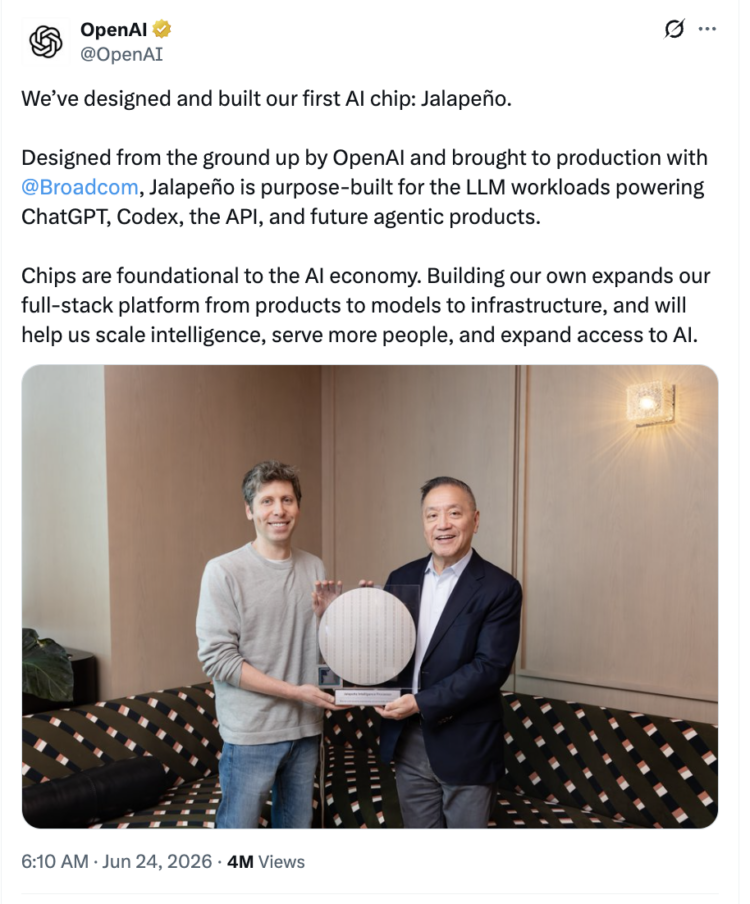
Yesterday, OpenAI and Broadcom announced Jalapeño, OpenAI’s first custom AI chip, built from scratch to run AI models faster and at roughly half the cost of current NVIDIA GPUs. It’s one of the most significant announcements in AI infrastructure this year. And while most of the coverage is focused on what it means for OpenAI’s competition with Nvidia, there’s a more practical story here that almost nobody is talking about: what happens to AI-powered productivity tools when running AI gets dramatically cheaper?
The short answer: everything gets smarter, faster, and more accessible. Including your email.
What Is the Jalapeño Chip, Exactly?
Jalapeño is a custom silicon chip designed by OpenAI and manufactured in partnership with Broadcom. It’s not a general-purpose processor. It’s built for one specific job: running large language models (LLMs) like ChatGPT and Codex as efficiently as possible.
OpenAI describes it as “a blank-slate design for modern LLM inference.” It wasn’t adapted from older hardware. It was designed from the ground up around how today’s AI models actually work. In early testing, it delivers better performance per watt than current state-of-the-art chips, with cost savings of approximately 50% compared to typical AI GPUs.
OpenAI plans to begin deploying Jalapeño by end of 2026, with full ramp-up expected in the first half of 2028. But the announcement itself is already reshaping how the industry thinks about AI infrastructure costs.

The Word Everyone’s Using: Inference
If you’ve been following AI news lately, you’ve heard the word “inference” a lot. It sounds technical, but the concept is straightforward.
There are two phases in AI: training and inference. Training is the expensive, slow process of teaching an AI model, feeding it billions of data points until it learns patterns. That happens once (or periodically). Inference is what happens every time you actually use the AI. Every ChatGPT message, every AI-suggested email reply, every automated summary. It happens billions of times a day, in real time, and it’s where most of the ongoing cost lives.
Until now, most inference has run on general-purpose GPUs, powerful, but not purpose-built for this job. Jalapeño changes that. A chip designed specifically for LLM inference can do the same work faster, with less energy, at lower cost. That’s not a small improvement. At scale, it’s transformative.
The Other Half of the Story: Micron and the DRAM Shortage
Chips don’t work alone. Every AI computation requires memory, specifically a type called DRAM (Dynamic Random-Access Memory), and a specialized variant called HBM (High Bandwidth Memory) that sits directly alongside AI chips to feed them data fast enough to keep up.
This is where Micron enters the picture, and where the story gets complicated.
Micron, one of the world’s largest memory chip manufacturers, recently warned that DRAM supply will fall short of demand well beyond 2026. AI is consuming over 50% of the total DRAM market this year. HBM, the high-performance memory that AI chips like Jalapeño depend on, is essentially sold out. The HBM market is projected to grow from $35 billion in 2025 to over $100 billion by 2028, and Micron is racing to keep up, with new fabs under construction in Idaho and New York and a $25 billion capital expenditure budget for 2026 alone.
What does this mean in practice? It means that even as chips get faster and cheaper, memory remains a bottleneck. The companies that build smart, memory-efficient AI applications, ones that do more with less, will have an edge over those that simply throw compute at every problem.


Why Cheaper AI Inference Changes Everything
Right now, running sophisticated AI features inside everyday tools is expensive. That cost gets passed down the chain, to software companies, and ultimately to users. It’s why many AI features are locked behind premium tiers, or why AI-powered tools feel sluggish compared to their non-AI counterparts.
When inference gets 50% cheaper, and gets faster at the same time, the economics of AI features change dramatically. Things that were previously too expensive to run on every email become viable. Features that required a paid plan can move to free. Response times drop. And AI agents, software that doesn’t just suggest actions but actually takes them on your behalf, become practical at a scale that wasn’t possible before.
We’re not talking about a distant future. Jalapeño ships at the end of this year. The ripple effects will be felt in the tools you use daily by mid-2027.
What This Means for AI Email Agents
The most exciting near-term implication of cheaper inference is what it does for AI agents in email.
Today’s AI email tools are mostly reactive: they suggest a reply, summarize a thread, or flag an important message when you ask them to. That’s useful, but it’s not the full picture of what AI can do. The reason most AI email features stop there is not intelligence. It is cost. Running a full AI agent that monitors your inbox, identifies action items, drafts follow-ups, schedules meetings, and routes messages intelligently requires many small inference calls happening continuously in the background. At current prices, that’s expensive to run at scale.
Cheaper inference, enabled by chips like Jalapeño, removes that constraint. The next generation of AI email tools won’t wait for you to ask. They’ll work in the background, surfacing what matters, handling the routine, and freeing you to focus on the parts of your job that actually require human judgment.
An AI agent that schedules your meetings automatically based on context, follows up with leads who haven’t responded, organizes your inbox by priority, and drafts responses in your voice, all without you lifting a finger, is not science fiction. It’s the logical next step, and the infrastructure to support it is being built right now.
What It Means for Your Gmail Productivity Right Now
You don’t have to wait for 2028 to benefit from the AI productivity shift. The tools that will evolve most dramatically are already in your browser, built on the same Gmail infrastructure that AI agents will eventually run on.
As AI tools become cheaper and more accessible, more people are feeding sensitive documents directly into LLMs. Before you do, tools like Save Emails to PDF and Redact PDF let you save and clean up documents before they leave your hands. A small habit that matters more as AI gets smarter.
These aren’t AI-powered in the large language model sense, but they’re the workflow foundation that AI agents will build on. Getting comfortable with automated email workflows now means you’ll be ready to hand off more to AI agents as they become capable of handling it.
The professionals who will get the most out of the coming AI wave aren’t the ones who wait for it to arrive. They’re the ones who have already automated the repetitive parts of their workflow and are ready to go further.
Who Wins When AI Gets Cheaper?
The obvious winners are the big AI labs. OpenAI gets to stop depending entirely on Nvidia and reduce its operating costs dramatically. Broadcom gets a major new customer and a seat at the AI infrastructure table. Investors in AI infrastructure plays get a catalyst.
But the less obvious winners are the small and mid-sized businesses that use AI-powered productivity tools every day. When inference costs drop, the tools they use get better without getting more expensive. Features that were premium become standard. AI that previously required an enterprise contract becomes available to a solo recruiter, a five-person sales team, or a freelance consultant.
The losers, in the medium term, are companies and professionals who haven’t started automating their workflows yet. The gap between teams that use AI-powered tools and teams that don’t is already significant. As inference gets cheaper and AI agents get smarter, that gap is going to widen faster than most people expect.
Frequently Asked Questions
What is OpenAI’s Jalapeño chip?
Jalapeño is OpenAI’s first custom AI chip, developed in partnership with Broadcom. It’s designed specifically for LLM inference, running AI models in response to user requests, and delivers roughly 50% cost savings compared to current NVIDIA GPU-based inference. Initial deployment is planned for late 2026, with full ramp-up in early 2028.
What is DRAM and why does it matter for AI?
DRAM (Dynamic Random-Access Memory) is the memory that AI chips use to process data. High Bandwidth Memory (HBM), a specialized form of DRAM, is essential for running large AI models at speed. Micron has warned that DRAM supply will fall short of AI demand well beyond 2026, making memory one of the key bottlenecks in AI infrastructure.
How will cheaper AI inference affect everyday software?
When AI inference gets cheaper, software companies can afford to run more sophisticated AI features at lower cost, pass savings to users, and unlock capabilities that were previously too expensive. In practical terms, AI features will be faster, smarter, and available to more people.
What is an AI email agent?
An AI email agent is software that acts autonomously on your behalf inside your email, automatically scheduling meetings, sending follow-ups, summarizing threads, prioritizing your inbox, and drafting responses in your writing style. These are becoming practical as AI inference costs fall.
Do I need to understand AI chips to benefit from AI productivity tools?
Not at all. The infrastructure improvements happening at the chip level will flow through to the tools you already use. The practical benefit is simpler: the AI tools you use will get better, faster, and cheaper over the next 12 to 24 months.
The Bottom Line
OpenAI’s Jalapeño chip is a hardware story on the surface. But underneath, it is a signal that the cost of running AI is about to drop significantly, and that the AI features that feel cutting-edge today will become standard infrastructure by 2028.
Micron’s DRAM shortage reminds us that this transition won’t be seamless. Memory constraints will create real bottlenecks, and the companies building efficient, lean AI applications will have an advantage over those that assume compute is infinite.
For professionals who use Gmail every day, the practical takeaway is this: the tools that automate your email workflow today are the foundation for the AI agents that will run it tomorrow. Getting started with automated scheduling, follow-ups, and email tracking isn’t just about saving time now. It’s about being ready for what comes next.
cloudHQ’s Gmail tools are free to install and work directly inside your inbox. See the full suite at cloudHQ.net.